Table of Contents
ToggleWebsite design and build with a WooCommerce shop and monthly memberships. Three weeks, brief to launch.
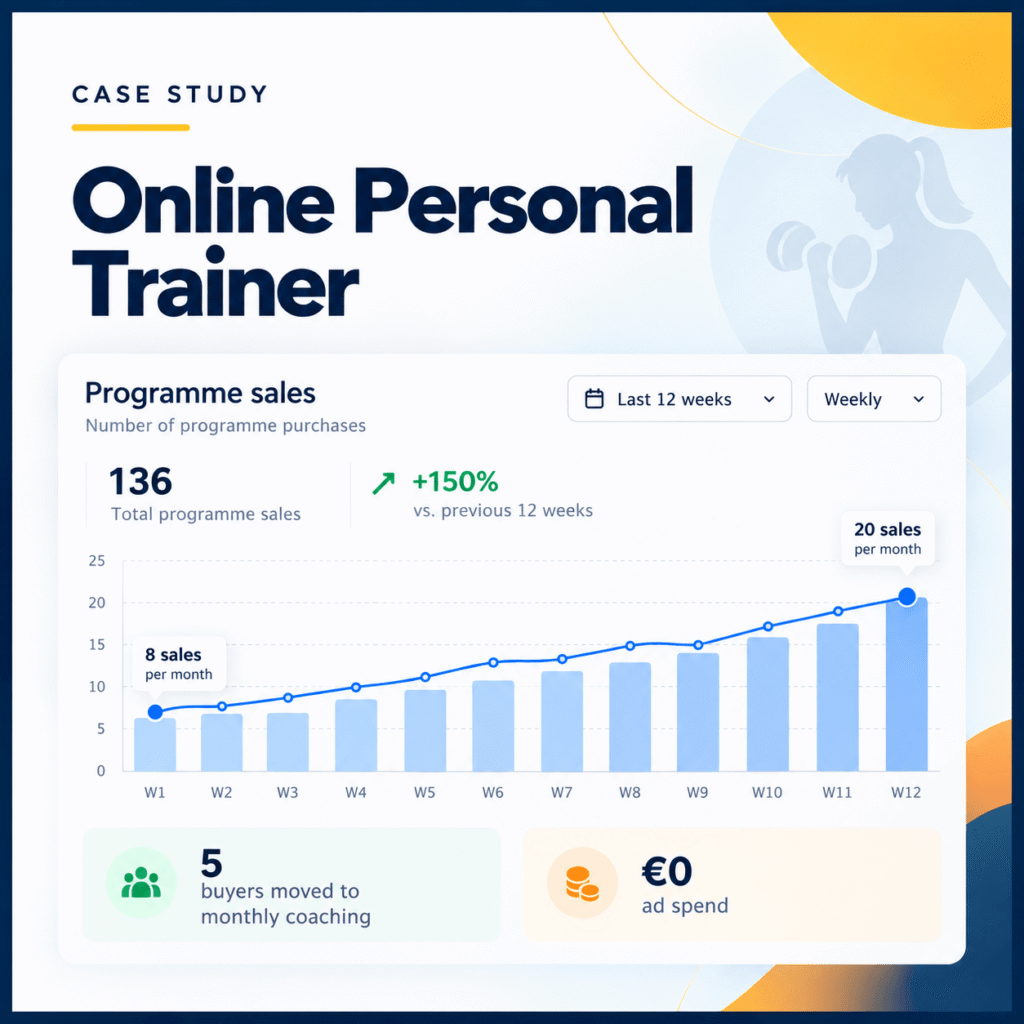
Programme sales went from 8 a month to 20 within 12 weeks of launch, and five buyers moved onto monthly coaching.
8 → 20/mo
3 weeks
€0 on advertising
Overview ( website design case study )
What we solved: Conversion · Lead generation · Mobile experience
| Client | Online personal trainer, Ireland |
| What they sell | Four one-off training programmes and three tiers of monthly coaching |
| What we did | Website design and build, WooCommerce shop, memberships with recurring billing |
| Build time | 3 weeks, brief to launch |
| Launched | August 2024 |
| Measured over | 12 weeks after launch |
| Ad spend | None |
The problem ( selling workout programmes through DMs )
A qualified personal trainer in Ireland had four programmes people wanted to buy. The only way to buy one was to message her.
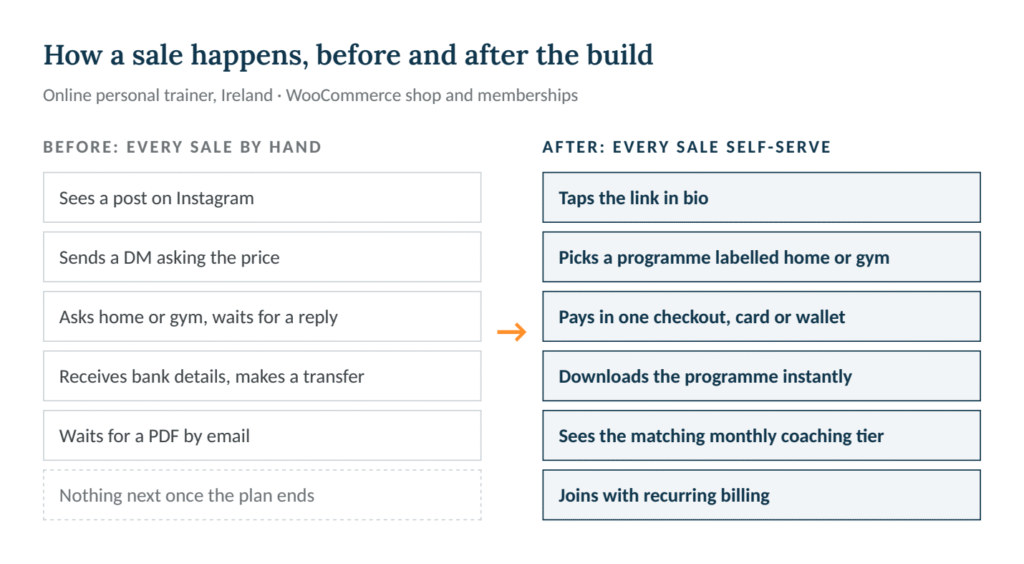
Every sale followed the same path. A follower saw a post on Instagram and sent a DM. She answered the price, then whether it worked at home or in a gym, then sent bank details. She waited for the transfer, checked it had arrived and emailed a PDF by hand. Each sale took around twenty minutes of her evening, and a share of buyers went quiet somewhere between the price and the payment.
Her sales were capped by the hours she could spend in her inbox. There was also nowhere for a buyer to go once a four-week programme ended, so the people most likely to pay for monthly coaching simply finished and left.
“Half my sales happen while I’m asleep now. I didn’t think a €26 plan would turn into monthly clients, but that’s where most of them came from.”
Owner, online personal training business, Ireland
5 things we found auditing an online coaching business
1. Every sale needed a conversation
Four manual steps stood between interest and a download: a DM, a price, a bank transfer and an emailed PDF. Each step was a place to lose the buyer, and every one of them needed her to be online.
2. The market sells coaching by application, not by checkout
Irish online coaches we reviewed start at €160 to €200 a month and ask buyers to apply or book a consultation first. The cheapest instant product we found was €60. Nobody offered a small, self-serve way in. Her €26 to €50 programmes could be exactly that. This is the finding the build was organised around, and the one an agency copying the market would have missed, because it would have built another application form.
3. Her buyers arrive from Instagram, on a phone, in the evening
Almost every enquiry started from a link in her bio. Whatever we built had to take someone from that tap to a finished payment on a small screen, with no account to create first.
4. There was no path from one programme to monthly coaching
A buyer finished a four-week plan and had nothing to move on to. The monthly tiers existed only as a message she sent when she remembered to.
5. The first question in every DM was “home or gym?”
The same few questions came up every time: price, equipment, length, what’s included. If a page answered them before the buy button, the conversation wasn’t needed. It’s the same principle as answering the funding question before the phone call, applied to a checkout instead of a booking.
7 things we built ( WooCommerce website for a personal trainer )
Every programme got its own page, much like building one page for every condition a patient searches for, so each buyer lands on the answer to their own question.
WHAT WE DID | WHY WE DID IT |
|---|---|
One page per programme, with price, length, equipment and what’s included above the button | Answers every DM question before it gets asked |
Home or gym label on every programme in the shop | The first question buyers asked, answered at a glance |
WooCommerce checkout with card, Apple Pay and Google Pay, no account required | Removes the bank transfer and the wait, so a sale can finish at 11pm without her |
Instant programme delivery on payment | No more emailing PDFs by hand |
Three monthly coaching tiers as memberships with recurring billing | Gives a finished programme somewhere to lead |
Order confirmation points to the coaching tier that matches the programme bought | Turns a one-off €26 buyer into a monthly client at the moment they’re most motivated |
Mobile-first layout built for link-in-bio traffic | Her buyers arrive on a phone, so the whole path is designed for a thumb |
3 weeks, brief to launch
WHEN | WHAT HAPPENED |
|---|---|
Week 1 | Reviewed her DMs and sales steps, compared entry prices across Irish online coaches, planned the shop and membership structure |
Week 2 | Designed and built the site, programme pages, shop, and the three membership tiers |
Week 3 | Payments, instant delivery, upgrade path, mobile testing across devices. Launched in August 2024 |
Weeks 1 to 12 after launch | Results measured against the three months before launch |
8/mo to 20/mo programme sales in 12 weeks ( online sales )
MEASURE | BEFORE | 12 WEEKS AFTER LAUNCH |
|---|---|---|
Programme sales a month | 8 | 20 |
Monthly coaching members | 0 | 5 |
How a sale happened | DM, bank transfer, emailed PDF | Self-serve checkout, instant download |
Sales needing a conversation | Every one | None |
Ad spend | €0 | €0 |
Why it worked ( selling without a sales call )
The rest of the market sells coaching by application. We built a front door that sells without one.
A low price took the risk out of the first purchase. A checkout that answered every question took out the conversation. And a membership tier waiting at the end of every order gave buyers a next step while they were still motivated. She stopped being the checkout, and the sales that used to depend on her evenings started happening on their own.
Programme sales went from 8 a month to 20 in 12 weeks. Five of those buyers went on to monthly coaching. None of it was paid for with ads.
FAQ
How much does a website cost for a personal trainer?
Our website builds run from $2,500 to $10,000 and up, depending on the number of pages and what the site has to do. A shop with memberships and recurring billing, like this one, sits above a brochure site because of the checkout, delivery and billing setup. This build took three weeks from brief to launch.
Do personal trainers need a website if they have Instagram?
Instagram is where this coach’s buyers found her, and it still is. What it couldn’t do was take a payment, answer the same five questions every time or deliver a programme at midnight. The website does those jobs, and Instagram sends people to it.
How do I sell workout plans online?
Give each plan its own page with the price, length, equipment and what’s included above the buy button. Take card and wallet payments with no account required, and deliver the plan the moment payment clears. That is the setup that took this coach from 8 programme sales a month to 20 in 12 weeks.
What is the best website platform for personal trainers?
It depends on what you sell. For one-off programmes plus monthly coaching, we used WordPress with WooCommerce, because it handles digital downloads, memberships and recurring billing on one site that the coach owns outright.
How do online coaches get clients without paid ads?
This coach spent nothing on ads. Her buyers came from Instagram and organic search. A low-priced programme gave them an easy first purchase, and the order confirmation pointed each one to the matching monthly tier. Five of them became monthly coaching clients within 12 weeks.
Is your inbox still your checkout?
Book a free 30-minute consultation. We’ll share a screen, look at your site together and show you where sales are getting lost.