
Table of Contents
ToggleBranding, design, development and copy for a pediatric neuropsychology practice in Pennsylvania.
Consultation requests went from 7 to 20 a month within four months, with nothing spent on ads.
Four years and three new clinicians later, it still runs on the same structure.
7 → 20
consultation requests/month, 4 months
6 weeks
brief to launch
$0
on advertising
Overview ( spa website design case study )
What we solved: Trust signals · Messaging · Site structure
| Client | Private pediatric neuropsychology practice, Pennsylvania |
| What we did | Brand identity, website design, WordPress development, all page copy |
| Launched | January 2022, six weeks from brief |
| Result | 7 to 20 consultation requests a month, four months after launch |
The problem ( practice website not bringing in new patients )
A board-certified neuropsychologist was opening her own practice after years in hospital settings. Her evaluations take a full school day of testing, cost a four-figure sum and sit outside every insurance network, so families pay up front and claim back what they can.
Pediatricians, schools and therapists were already sending families her way. Most of those families looked her up before they called. What they found answered none of the three things they wanted to know: what the evaluation costs, what it involves, and how to explain it to their child. Many never called.
“Families call having already read which evaluation answers their question. The consultation starts in the right place.”
Founder and clinical neuropsychologist
5 things we found auditing a private practice website
1. The parent pays, but the child has to walk in
Every practice in the market wrote for the adult making the decision. Nobody wrote for the eight-year-old who would spend five hours being tested. Parents were putting off the booking because they did not know how to tell their child, and no amount of credential copy fixes that.
2. Parents search for a worry, not a test name
Nobody types “psychoeducational evaluation.” They type “why does my child struggle in school” or “is this ADHD or just being a kid.” A services list sorted by clinical name forces a worried parent to diagnose their own child before they can find the right page.
3. Out of network means price is the first question, and the one nobody wants to ask on the phone
A family weighing a four-figure bill wants the number, what it covers and what insurance might return, before they make contact. We had seen the same hesitation before when answering the funding question before the phone call turned a dietitian’s site around.
4. Six kinds of evaluation meant six different searches
ADHD, autism, dyslexia, giftedness, concussion and school-requested evaluations each have their own searcher, their own worry and their own length of testing. One page could not rank for all six, the same lesson as building one page for every condition a patient searches for.
5. Referrers check credentials before they pass on a family’s name
A pediatrician or school psychologist recommending a private evaluator is putting their own judgment on the line. They look for board certification, hospital training and a record of working with schools, and they look for it quickly.
7 things we built ( website design for private practices )
| WHAT WE DID | WHY WE DID IT |
|---|---|
| A calm, clinical brand identity that reads as warm rather than hospital | Parents arrive anxious. The first impression had to lower the temperature, not raise it. |
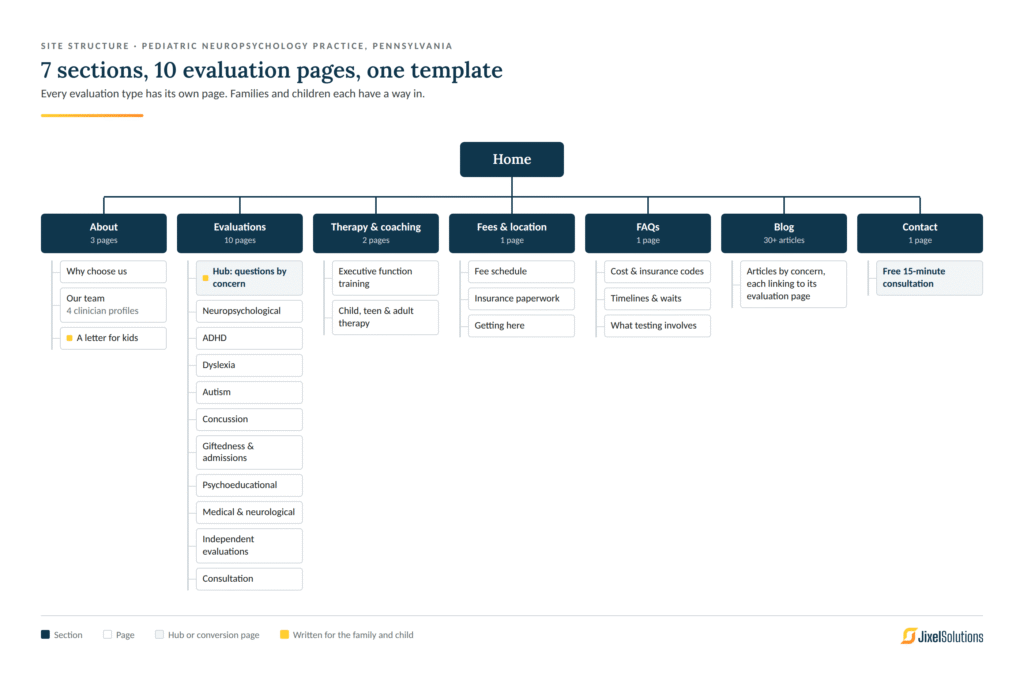
| A letter written directly to the child | Plain language on what the day involves, when the breaks are and why there are no wrong answers. Parents use it to start the conversation at home. |
| An evaluations hub sorted by concern | Four groups (thinking and learning, attention, day-to-day life, social and emotional), each question pointing to the evaluation that answers it. |
| One page per evaluation type, on one template | Six at launch, each matched to its own search. New evaluation types slot in without a redesign. |
| A fees and insurance page with nothing held back | Every fee, what it includes, the out-of-network paperwork and the billing codes to ask an insurer about. Price is answered before the call. |
| A credentials page for referrers | Board certification, hospital background and school collaboration, stated plainly for the professional skimming it between appointments. |
| One next step, on every page | A free 15-minute consultation. Families who are unsure which evaluation they need are told that finding out is what the call is for. |
6 weeks, brief to launch
WHEN | WHAT HAPPENED |
|---|---|
Weeks 1–2 | Discovery across three readers: parents, children and referrers. Brand identity and site structure signed off. |
Weeks 3–4 | Copy for every page, including the letter to the child, the concern-led hub and the fees page. |
Weeks 5–6 | Design and build on WordPress and Elementor, mobile first. Testing, launch, and Google Business Profile pointed at the new site. |
7/mo to 20/mo consultation requests in 4 months
MEASURE | BEFORE LAUNCH | FOUR MONTHS AFTER |
|---|---|---|
Consultation requests a month | 7 | 20 |
Evaluation types with their own page | 0 | 6 |
Fees published before the call | None | Every evaluation |
Spent on advertising | $0 | $0 |
The practice has since grown from one clinician to four, and from six evaluation pages to ten, without a rebuild. The structure we set in 2022 is the one carrying it today.
Why it worked ( psychology practice website )
It answered both people who have to say yes. The parent got the price, the process and the credentials. The child got a letter.
It met parents at their worry. Nobody had to know the clinical term to find the right page.
It was built for the practice she was planning. Four years of growth added pages instead of forcing a new site.
Frequently asked questions
How much does a psychologist website cost?
Our website builds run from $2,500 to $10,000 and up, depending on the number of pages and whether branding and copy are included. This project covered all three: brand identity, a page for every evaluation type, and every word of copy.
Source: searched as written; ranks as an article title on page one (“How much does a psychologist website cost?”, Creative Baguette) alongside BrighterVision’s therapist website cost guides.
Should you list your fees on your private practice website?
For an out-of-network or private-pay practice, we think yes. Families weighing a four-figure bill want the number, what it covers and what insurance might return before they call. This practice publishes every fee, and consultation requests went from 7 to 20 a month in four months.
Source: searched as written; answered on page one by TherapyNotes (“Should You List Your Fees on Your Practice’s Website?”) and a private practice podcast episode with the same title.
What should a psychologist website include?
A page for every service people search for, fees and insurance information, credentials for referrers, and one clear next step. For a practice that works with children, we add a page written for the child. It gives parents the words to explain the appointment at home.
Source: searched as written; page-one results from Creative Baguette (“What should a psychologist website include?”), Anadea and BrighterVision.
How long does it take to build a therapist website?
This one took six weeks from brief to launch, including brand identity and all the copy. The first two weeks went on research and structure, so the build itself moved quickly once every page had a job.
Source: searched as written; page-one results from therapist web design agencies (ClicksGeek) and DIY website builders.