
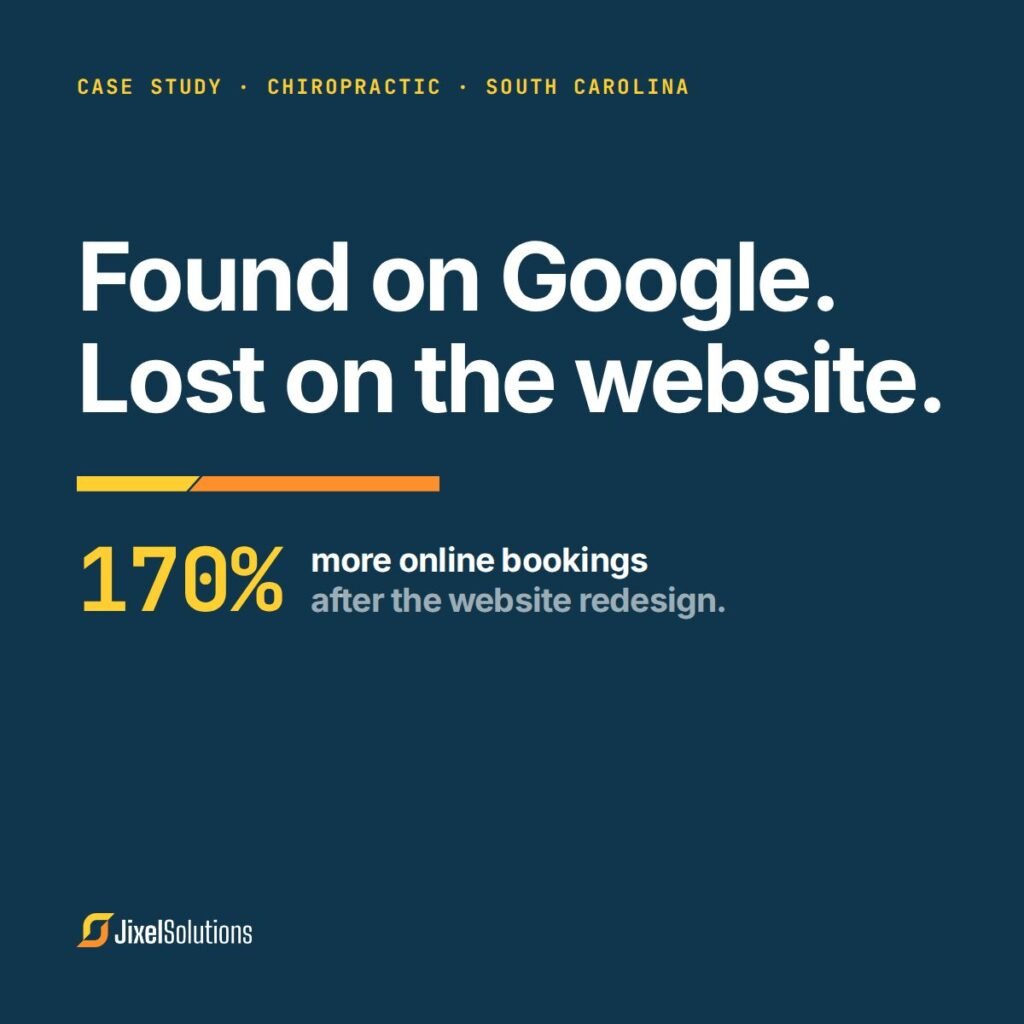
Two chiropractic clinics in South Carolina, 25 miles apart, in two opposite markets.
We rebuilt the website in three weeks.
Online bookings went from 10 a month to 27 within sixty days of launch.
10 to 27
Online bookings/month,
60 days after launch
3 weeks
Audit, build and launch,
brief to live
$0
At a glance
Client | A chiropractic, rehabilitation and wellness practice in South Carolina |
Locations | Two clinics, 25 miles apart |
Engagement | Website design and build, with local search setup for both locations |
Build time | 3 weeks, brief to launch |
Results measured | 60 days after launch |
What we solved: Local visibility · Site structure · Conversion
The problem
Two clinics. Four chiropractors between them. A perfect 5.0 rating across 211 Google reviews, which is a standing almost nobody in the category holds at that volume.
Only 10 online bookings a month.
The practice had spent years earning a reputation its website was hiding. Patients who already knew the doctors found their way in. Everyone else searching for a chiropractor in either town found a competitor.
“Our patients love us. That was never the problem. The problem was that anyone who hadn't already met us had no reason to pick us over the place down the road.”
Founder and lead chiropractor
5 things we found
We audited both markets before writing a line of copy, including every competing practice within
range of each clinic.
Two locations, two opposite markets
The clinics sit 25 miles apart, and they are not competing in the same world.
Measure | Location A, city of ~75,000 | Location B, town of ~5,000 |
Competing practices | 9+ | 4 |
Most-reviewed rival | 662 reviews | 10 reviews |
National franchise nearby | Yes | No |
The actual problem | Getting noticed | Being found at all |
Location A is a fight for attention against an established clinic with 662 reviews and a franchise two miles down the road. Location B is an open market where the practice was already the strongest-reviewed option in town, and most residents still drove 25 miles north because they didn’t know it existed.
One website had to make two opposite arguments. It was making one generic one, and winning neither.

Four service lines were being sold as one thing
Service line | Who’s searching | Local competition |
Auto accident & injury | Urgent, insurance or attorney-coordinated | Moderate |
Prenatal & family care | Researching, longest patient retention | Moderate |
Shockwave therapy | Chronic condition, cash-pay | Almost none |
General chiropractic | Comparison shopping | Heaviest |
Three of these four were markets the practice could lead outright. All four were funnelled through the single most competitive term in the category. A private clinic on Harley Street had the same problem at a larger scale, and building one page for every condition a patient searches for was the fix there too.
Patients choose a doctor, not a clinic
Across every review on both locations, not one said the practice was great. Every single one named a specific doctor. That is the practice’s entire advantage over the franchise down the road, where patients see whoever is on shift. The website didn’t say who the doctors were.
211 five-star reviews, doing no work
A 5.0 across 211 reviews is a stronger trust signal than any headline anyone could write. It appeared nowhere a visitor would see it before deciding whether to book.
Nothing answered “will this be covered?”
The most common reason a first chiropractic appointment doesn’t get booked isn’t price. It’s uncertainty about insurance. Most practices leave patients to phone and ask. Most patients don’t phone. It’s the same move that worked for a dietitian in regional Queensland, where answering the funding question before the phone call did most of the work.
6 changes we made
We rebuilt the site in three weeks around six decisions.
What we did | Why we did it |
Gave each location its own identity: address, phone, doctors, directions and map listing | Two towns, two arguments, two sets of local search results to compete in |
Built a dedicated page for every service line | Four chances to rank instead of one, three of them in markets nobody local was contesting |
Named, photographed and credentialed every doctor, and assigned each to a clinic | The credential is the offer. Patients weren’t choosing a practice, they were choosing a person |
Put booking on every page, with a permanent action bar on mobile: schedule, call or text, directions | The decision to book happens on a phone, frequently after the office has closed |
Stated payment and coverage openly: insurance, VA community care, HSA, FSA, self-pay, personal injury | Removes the single most common reason a first appointment never gets made |
Wrote a six-step new-patient walkthrough | First-time chiropractic patients don’t know what happens in the room, and uncertainty costs bookings |
We installed tracking at launch, so from day one every booking, call and text could be traced back to the page and the search that produced it. Most practices this size have never seen that data.
3 weeks to launch, 60 days to results
Phase | What we delivered |
Weeks 1–3 | Market and competitor audit across both towns. Build, content and per-location structure. Tracking installed. Launch. |
Days 1–30 after launch | Claimed, categorised and optimised both Google Business Profiles, treating the second location as its own market rather than a satellite. Service pages indexed. First attribution data delivered. |
Days 31–60 after launch | Review generation live. Conversion pass on the highest-value service path. Full read against baseline. |
10 to 27 bookings a month in 60 days
Measure | Before | 60 days after launch |
Online bookings | 10/month | 27/month |
Auto accident enquiries | 2/month | 14/month |
Google reviews, both locations | 211 | 260 |
No ad spend. No change to pricing, staffing or hours.
Why it worked
The practice was never short of skill, and it was never short of goodwill. It held a perfect rating across 211 reviews in a category where 4.8 is considered excellent.
What it had was two different problems in two different towns, four different kinds of patient, and one website treating all of it as a single undifferentiated thing.
We didn’t manufacture a reputation. We stopped the website hiding one that already existed.
Questions practice owners ask us
Does every clinic location need its own page?
If the locations compete in different markets, yes. In this build one town had nine competing practices and the other had four, and the strongest competitor in the second town had ten reviews. Those two situations need opposite arguments, and a single “areas we serve” page makes neither of them.
How long does a chiropractic website rebuild take?
Three weeks from brief to launch on this one, covering the market audit, the build, the content and the tracking. Timelines move with the number of service lines and how much content already exists.
We already have great reviews. Why would a new website change anything?
Reviews only work on people who reach the page. This practice held a 5.0 across 211 reviews and was getting 10 online bookings a month, because nobody who hadn’t already heard of them ever arrived. The rebuild didn’t create the reputation. It stopped the site hiding it.
How much of the result came from SEO and how much from the website?
They aren’t separable. The service pages that rank are the same pages that convert. No money went to advertising, and nothing changed about the practice’s pricing, staffing or hours.
Do you work with practices outside the US?
Yes. We work with founder-led businesses worldwide.
What would you look at first on our site?
The page that carries the most revenue, and whether someone can book from it on a phone at 9pm. That answers more than most audits do.
Want to know what your website is costing you?
Send us your URL. We’ll show you what’s costing you leads, where those patients are going instead, and what we’d fix first.
Jixel Solutions handles website design and development for founder-led businesses, then drives the growth with SEO and content.