We designed and built a private clinic’s website in London in four weeks.
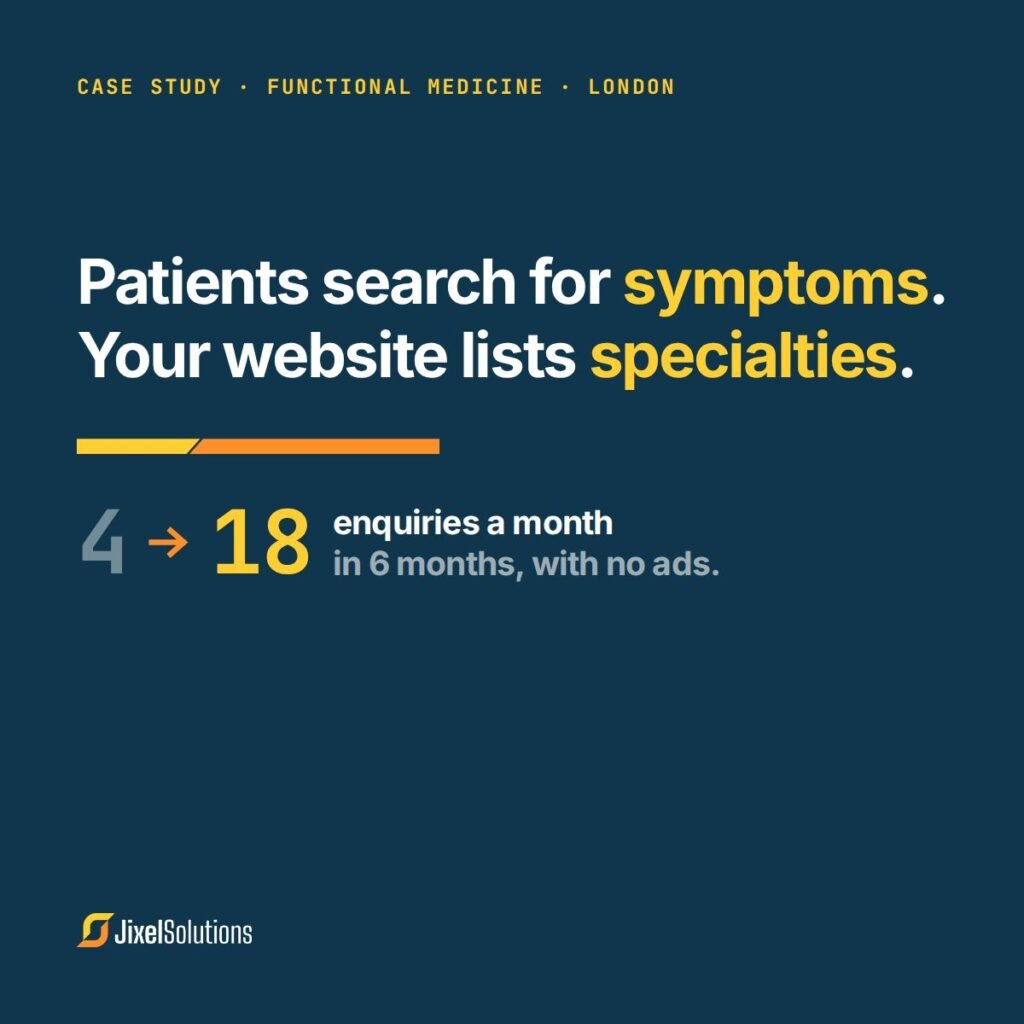
Twenty-one condition pages on one structure, and 4 to 18 enquiries a month within six months.
Four years on, that structure is still carrying the site.
4 → 18/MONTH
4 WEEKS
Brief to launch
£0
At a glance
ITEM | DETAIL |
Client | A private functional medicine clinic on Harley Street, London. Name withheld. |
Pages | 21 condition pages under one hub, plus price, team, process and contact |
Sector | Private healthcare, founder-led practice |
Engagement | Website design and build |
Scope | Information architecture, design, WordPress build, launch |
Timeline | 4 weeks, brief to launch |
Stack | WordPress with Elementor, client-editable |
Not in scope | SEO retainer, ongoing content, advertising |
What we solved: Site structure · Local visibility · Conversion
The problem
A clinic treats conditions. A patient has a symptom. Those are not the same thing, and most clinic websites are built on the first one.
This practice treats complex chronic illness. Gut disorders, thyroid problems, autoimmune conditions, chronic fatigue. The patients who need it most have usually been round the system already. They have had the tests, been told the results were normal, and left with the symptom they walked in with. By the time they search, they are not searching for a category of medicine. They are searching for the thing that is wrong with them.
The clinic came to us with a single page that listed every condition they treat as a bulleted list. It had been built as a brochure by a previous developer, and it read like one. The practice was credible. The website made it look like a directory entry.
“We knew what we were good at. The website just listed it. It never explained why anyone should start with us.”
Clinic founder
5 things we found
Nobody searches for functional medicine
They search for SIBO, for IBS, for Hashimoto’s, for why they are still exhausted after a normal blood panel. The category name is the clinic’s word for what it does. It is almost never the patient’s word for what they have.
One page cannot rank for twenty-one conditions
Search engines rank pages, not practices. A single services page listing every condition competes for all of them and wins none, because it says nothing specific about any one of them. It is the most common structural mistake we find when we run a website audit.
The decision is made on the condition page, not the homepage
A patient who lands on a leaky gut page is asking one question. Has this clinic treated exactly this, in people like me. A homepage cannot answer that. Twenty-one condition pages can answer it twenty-one different ways.
Harley Street is a search term, not just an address
Patients type the street into the search bar because it stands for a standard of care. That belongs in page titles and URLs, not only on the contact page.
In private healthcare, price is the unspoken objection
A consultation that is not priced on the website gets priced by the patient’s imagination, and their imagination is usually worse than the real number. Publishing it costs a few enquiries and saves every one of them a wasted call. It is the same principle as answering the funding question before the phone call, which worked for a dietitian in regional Queensland.
6 changes we made
WHAT WE DID | WHY WE DID IT |
A three-level condition structure: hub, category, condition | Digestive Health holds SIBO, IBS, Candida, leaky gut and H. pylori beneath it. Each page can go deep without the hub losing its shape. |
A single condition page template, built once | The clinic can add a condition without a developer. Twenty-one pages run on it today. The twenty-second costs them an afternoon, not a quote. |
URLs written in patient language | The IBS page sits at a URL naming the condition, the city and the street. The nutrition page does the same. The address does search work on every page, not one. |
A published consultation price and packages page | It answers the question every prospective patient has and none of them email to ask. |
One conversion action across the whole site | Book an appointment. Same words, same destination, on every page. A clinic site with four competing calls to action converts on none of them. |
Telehealth treated as a service, not a footnote | The clinic is on one street in London and treats patients who are not. Giving remote consultation its own space widens the catchment to anyone who can find the site. |

4 weeks, brief to launch
WEEK | PHASE |
Week 1 | Structure. Condition taxonomy, page map, URL scheme, conversion path. |
Week 2 | Design. Homepage, condition page template, price page, contact. |
Week 3 | Build. WordPress, responsive, client-editable templates. |
Week 4 | Content load, review and launch. |
4 to 18 enquiries a month in six months
MEASURE | BEFORE | SIX MONTHS AFTER LAUNCH |
Enquiries a month | 4 | 18 |
Conditions with a dedicated page | 0 | 21 |
Pages able to rank | 1 | 24 |
Organic sessions a month | 310 | 1,900 |
Spent on advertising | — | £0 |
Style: “Before” column in muted grey, “after” column in bold navy. Never orange or red.
Why it worked
The structure was the strategy. Everything else on that project was execution.
Most clinic websites are organised the way a practice thinks about itself. Services, approach, about us, contact. That map is correct and useless, because it asks a sick person to translate their symptom into the clinic’s vocabulary before they can find the page that would reassure them. We inverted it. One page per condition, named the way a patient would name it, reachable in one click from a hub that does nothing except route people to the right one.
That decision also aged well. A structure built around symptoms keeps absorbing new ones. The clinic has added conditions, articles and a review feed since launch, and the architecture underneath has not needed rebuilding. Four years is a long life for a website. It is a normal life for a website whose structure was right on day one.
We did the build. The clinic did the medicine. The site’s job was to stop the second one from being invisible to the people who needed it.
Questions about this project
How should a clinic website be structured?
How long does a clinic website take to build?
Do I need a separate page for every service?
If customers search for them separately, yes. The test is whether someone would type that specific term into a search bar. If they would, it needs its own page.
Can I add pages myself after launch?
Yes. This build shipped a reusable condition page template, and the clinic has added pages since launch without going back to a developer.