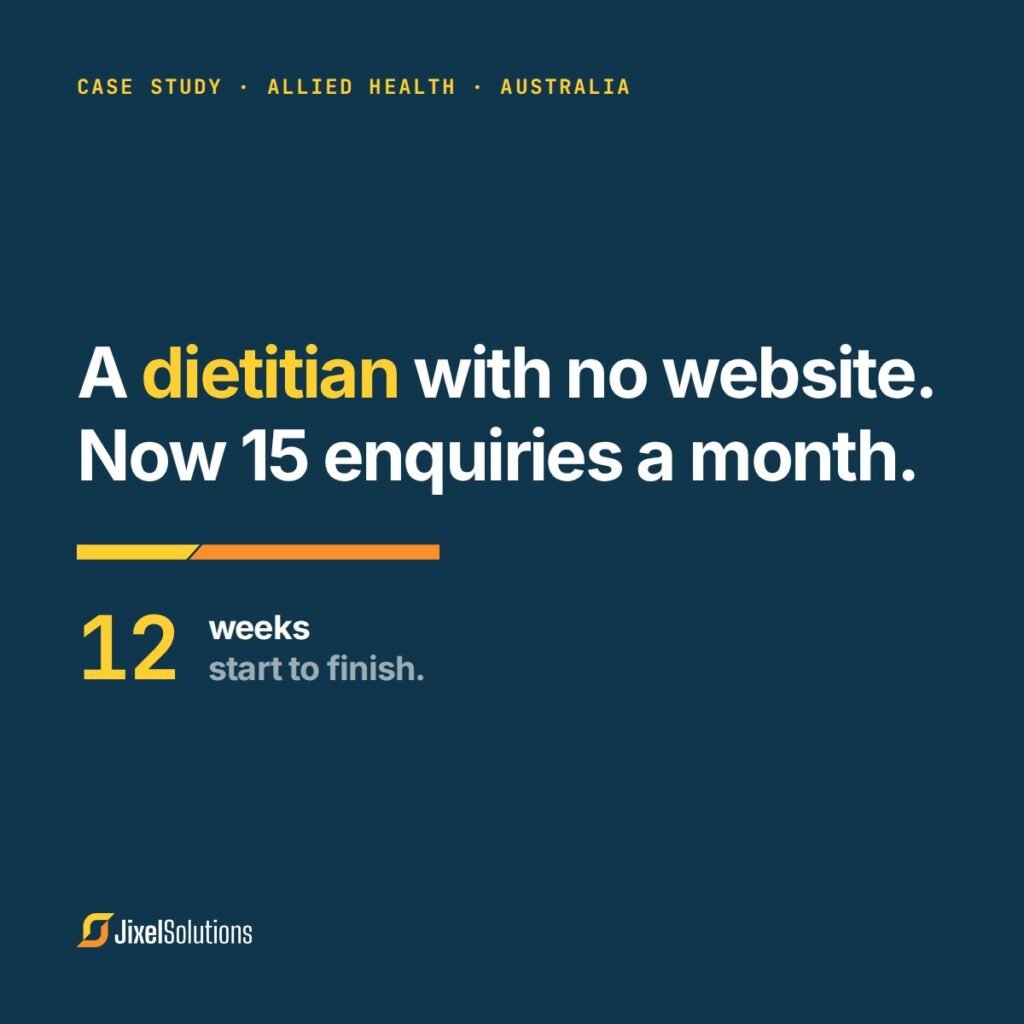
Website design, development and content. Three weeks, brief to launch. Not one dietitian in this regional Queensland town had a single Google review. 15 enquiries a month, 12 weeks after launch.
0 → 15
enquiries a month 12 weeks after launch
3 weeks
$0
At a glance
|
Client |
An Accredited Practising Dietitian, sole practitioner |
|
Industry |
Dietetics and nutrition, funded and private care |
|
Market |
Regional Queensland |
|
Engagement |
Website design, development and content |
|
Launched |
March 2026 |
|
Measured |
12 weeks after launch |
|
Advertising spend |
None |
What we solved: Conversion · Messaging · Local visibility
The problem
A dietitian opens a solo practice in a regional town. She holds the credentials, she is a registered NDIS provider, and she takes Medicare, DVA and Support at Home clients. What she does not have is any way for those people to find her. No website, no search presence, nothing to send a referring GP.
The market looked easy from the outside. A handful of dietetics practices in town, none of them large. Then we pulled the Google data and found something stranger. Not one dietitian-first practice in that town holds a single Google review. Not the new ones, not the established ones, none. The only local businesses with any review volume at all are a gym and a wellness centre that offer dietetics as a side service.
That reads like an open goal. It is not. It means someone searching for a dietitian there has no way to tell any of them apart, so they fall back on the two things they can verify in ten seconds. Will this be covered, and can they come to me.
“I kept getting the same first question on the phone. Not what do I eat. Will Medicare pay for this, and do I need to see my GP first. I was answering that twenty times a week before anyone ever booked.”
5 things we found
- Zero reviews across the entire category, so the usual local playbook does not apply.
Every dietitian-first practice in the market sits on zero reviews. There is no incumbent to out-review and no rating for a buyer to sort on. The site had to win on verifiable facts, because reputation signals do not exist in this category yet. - The strongest competitor is two hours away and registered in all 8 states and territories.
The provider best positioned for funded clients in the area is a coastal practice running satellite rooms inside a local GP clinic. A national operator wearing a local address. The one thing it cannot match is a dietitian who lives in the town and will come to the house. - Four funding pathways, four different opening questions.
An NDIS participant asks whether the provider is registered. A Medicare client asks whether they need a GP plan first. A DVA client asks whether they are eligible. A family using Support at Home asks whether someone will actually come to Mum’s kitchen. Same practitioner, four different questions, and a site that answers one of them loses the other three. - The person searching is often not the person eating.
Reduced appetite, unintentional weight loss and “Dad has stopped eating properly” get searched by adult children and carers, not by the patient. That reader needs different language and converts on reassurance rather than clinical credibility. - Referrers are a second audience and they will not queue.
GPs and support coordinators send clients in volume. They need a route that is not the same inbox as a general enquiry.
8 changes we made
|
What we did |
Why we did it |
|
Organised the entire page around four named funding pathways, each with its own block and a plain eligibility answer |
Coverage was the first question on every enquiry call. We moved the answer onto the page and took it off the phone |
|
Put the practitioner, the credential and the town together, high on the page |
With no reviews anywhere in the category, verifiable facts are the only proof available |
|
Wrote a section addressed to carers, families and support coordinators rather than only to patients |
The searcher is frequently the daughter, not the client |
|
Made in-home consultation a stated service instead of a footnote |
It is the one thing a multi-state provider running satellite rooms cannot replicate |
|
Built a separate referral contact route for GPs and support coordinators |
Referrers send repeat volume and should not sit behind general enquiries |
|
Answered referral, eligibility and first-appointment questions in a plain FAQ |
These are the objections that stop a booking, and they were being handled one call at a time |
|
Kept the page lean and in plain language, with no keyword stuffing |
The client’s brief, and it happens to be what the reader needs, because this decision is administrative rather than persuasive |
|
Wrote the title, description and social preview around the town and the funding pathways |
That is the phrasing people use when they are working out whether they are covered |

3 weeks, brief to launch
|
Week |
What happened |
|
Week 1 |
Market and competitor audit, Google Business data on every dietetics provider within 70km, funding pathway research, structure agreed |
|
Week 2 |
Copy written around the four pathways and the two audiences, design and build |
|
Week 3 |
Technical setup, on-page SEO, Google Business Profile alignment, launch |
0 to 15 enquiries a month in 12 weeks
|
|
Before |
12 weeks after launch |
|
Online enquiries per month |
0 |
15 |
|
Time from brief to live site |
— |
3 weeks |
|
Advertising spend |
$0 |
$0 |
Why it worked
The site does not try to convince anyone that nutrition matters. The people searching had already accepted that, usually because a GP told them so. What stopped them was administrative, and administrative doubt kills a booking just as efficiently as a bad first impression does.
So the page answers the administrative questions first and the clinical ones second. Coverage, referral, eligibility, location, and whether someone will come to the house.
The second reason is timing. A market with no reviews in it is a market where the first practice to build a real presence sets the standard everyone else gets measured against. We built for the position that was sitting vacant rather than the one already occupied, because in that town nobody occupies anything yet.
Frequently asked questions
How long does a website like this take to build?
Does a new practice with no reviews need a website first, or reviews first?
Do you work with NDIS registered providers and allied health practices?
Yes. Funded care adds a layer most websites handle badly, because eligibility questions decide the booking before clinical credibility ever comes into it.
Was any of this driven by advertising?
No. Nothing was spent on ads. The results came from the website itself and how it was structured, found and written.
Can you do the same for my practice
Book a consultation and we will look at your market the same way, starting with the competitor and Google data before anything gets designed.
Ready to see what your market actually looks like?
We start every build the same way. Competitor data first, design second. That is how a finding like this one gets spotted before a single page is designed.