Table of Contents
ToggleWebsite design and build for a group mental health practice in New Jersey. Four weeks, brief to launch.
Therapy and psychiatric care under one roof, and the old website showed both as a bullet list.
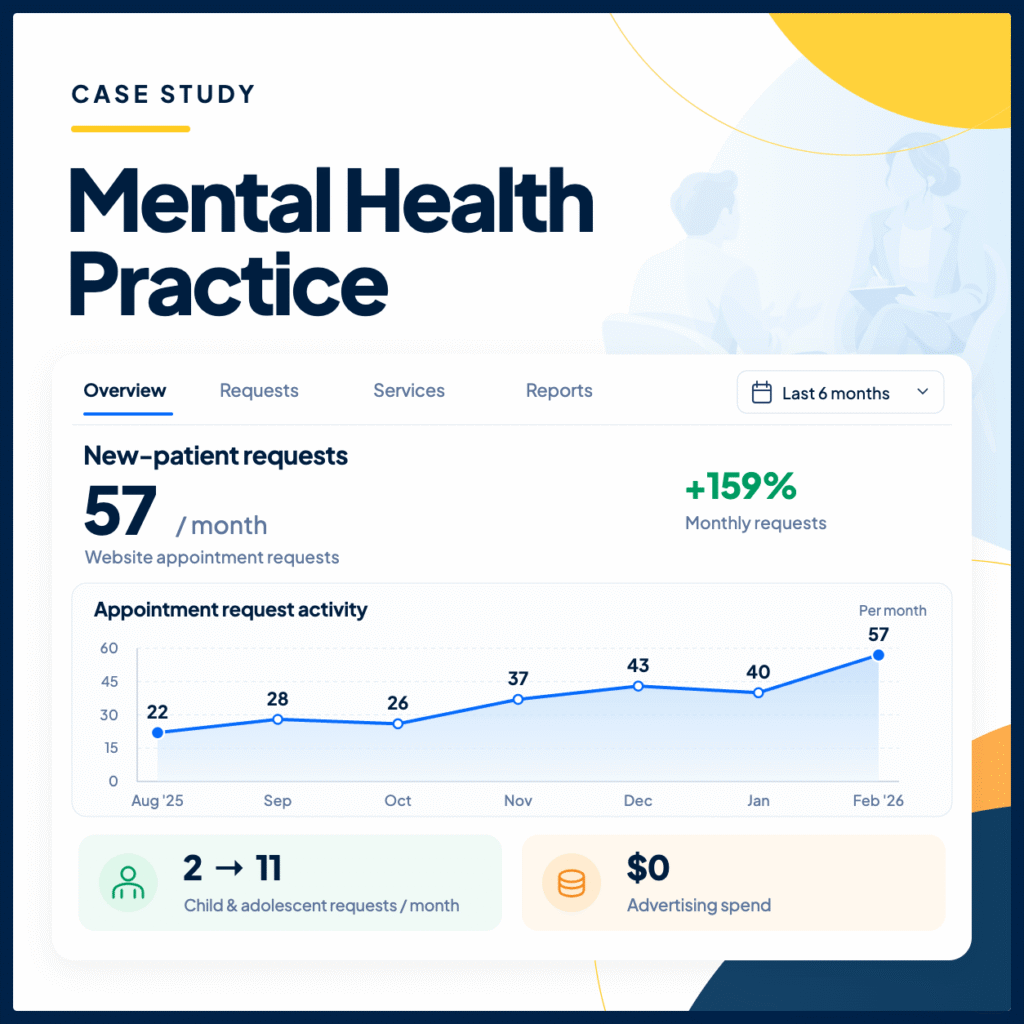
22 to 57 new patient requests a month, six months after launch.
22 → 57
new patient requests a month
4 weeks
brief to launch
$0
on advertising
Overview (mental health website design case study)
What we solved: Site structure · Conversion · Trust signals
| AT A GLANCE | |
| Business | Group mental health practice, New Jersey. Therapy for adults, couples, families, children and teens, plus psychiatric medication management, in person and by telehealth |
| Before | A website that listed seven services on one page, with no answer on insurance, hours or who you would see |
| Scope | Website design and build, site structure and copy. Provider pages added a year later |
| Timeline | Four weeks from brief to launch, August 2025 |
| Result | 22 to 57 new patient requests a month, six months after launch |
| Advertising | $0 |
The problem (therapy website not getting new patients)
People rarely look for therapy by a practice’s name. They start with a worry: a teenager who has stopped talking, a marriage under strain, a medication that no longer helps. Then they ask three questions before they pick up the phone. Can they help with this? Can I afford it? Who will I see?
The practice had good answers to all three. It offered therapy for every age and psychiatric medication management in the same office, took major insurance, Medicaid and Medicare, and saw people in person or by telehealth. Its website answered none of them. Seven services sat in a single bullet list, with no page for any of them and nothing about insurance, hours or the people behind the work.
Nearby, therapy came mostly from solo practices and psychiatric care from separate ones. This was one of the few places offering both, and nobody could tell until they called.
“We had therapy and psychiatry under one roof the whole time. The website finally made that obvious before anyone picked up the phone.”
Owner, mental health practice, New Jersey
5 things we found auditing a group practice’s website
1. The practice’s biggest advantage was a bullet point
Therapy and psychiatric medication management in one practice means a patient doesn’t have to coordinate two offices. On the old site it was one line in a list of seven.
2. People search for their situation, not a therapy name
A parent looks for help for an anxious teenager. A couple looks for marriage counseling. A list of service names gives neither of them a page to land on or a reason to believe it fits. It’s the reasoning behind writing one page for the parent and one for the child.
3. Insurance was the first question, and nothing answered it
The practice accepted major insurance, Medicaid and Medicare, with a sliding scale for private pay. The website never said so, so people had to call just to find out whether they could afford to call. We’ve seen the same thing before, and fixed it by answering the funding question before the phone call.
4. The first step is the hardest one
5. A team of clinicians read like a single therapist
The site spoke about “our team” without showing anyone in it. People choose a therapist as much as a service, by specialty, the ages they work with and the language they speak.
6 things we built (website design for therapists)
WHAT WE DID | WHY WE DID IT |
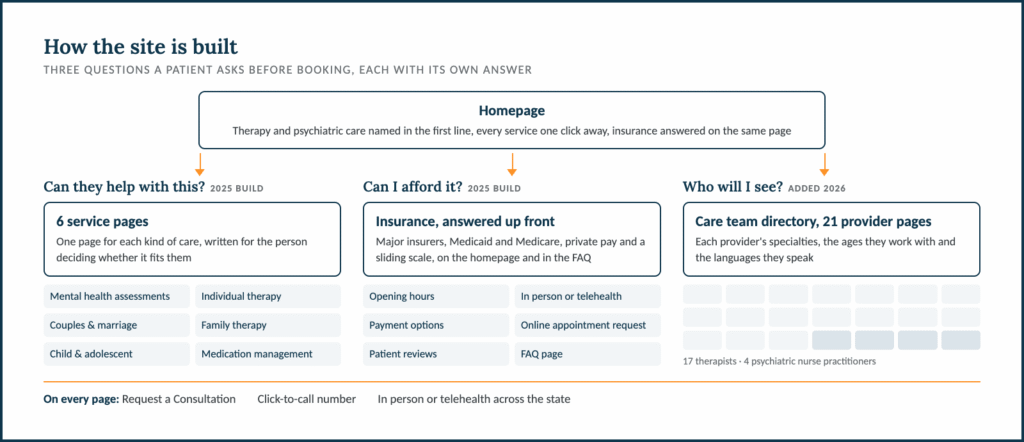
A homepage that names therapy and psychiatric care in its first line, with every service one click away | The advantage competitors couldn’t offer is the first thing a visitor reads |
Six service pages: assessments, individual therapy, couples and marriage counseling, family therapy, child and adolescent therapy, medication management | Each kind of care has a page someone can land on from a search and recognise their situation in |
Insurance, Medicaid, Medicare, private pay and the sliding scale answered on the homepage and in the FAQ | The question that stopped people booking is settled before the call |
Opening hours, in person or telehealth, and an online appointment request on every page | Someone who isn’t ready to phone can still take the first step |
Patient reviews and a FAQ page covering payment, appointments and telehealth | Hesitant visitors hear from people who have already been |
A year later: a care team directory with 21 provider pages, each with specialties, age groups and languages | People can choose the person before they call, not only the service |
It’s the approach behind building one page for every condition a patient searches for, applied to kinds of care.
4 weeks, brief to launch
WHEN | WHAT HAPPENED |
Week 1 | Research on nearby practices, what they offered and how people search for therapy and medication management. The questions the front desk hears most |
Week 2 | Structure and design, built around the three questions and the practice’s own colors |
Week 3 | Copy for the homepage, six service pages and the FAQ, written for the person deciding, not the clinician |
Week 4 | Build, testing on phones, online appointment request connected, launch in August 2025 |
22/mo to 57/mo new patient requests in 6 months (online booking)
MEASURE | BEFORE LAUNCH | 6 MONTHS AFTER LAUNCH |
New patient requests a month | 22 | 57 |
Child and adolescent requests a month | 2 | 11 |
Advertising spend | $0 | $0 |
Calls, contact forms and online appointment requests from people not yet in care. Before: the month before launch. After: the sixth month after launch (February 2026), before the provider pages.
Why it worked
We didn’t make the practice sound bigger. We made it easier to choose: every question a person asks before booking now has its own answer, in the order they ask it. Provider pages added a year later answer the last one.
Six months after launch, new patient requests had more than doubled, and requests for children and teenagers had gone from 2 to 11 a month, with nothing spent on ads.
Frequently asked questions
How much does a website cost for a therapy practice?
Our website builds range from $1,000 to $10,000 or more, depending on page count and scope, and most land between $2,000 and $3,000. A group practice with a page for each service and each clinician sits toward the upper part of that range, because every page is written for its own reader. We quote a fixed price after a call, once we know your services and your team.
Should therapists list insurance on their website?
Yes. Whether you take insurance is one of the first things a new patient checks, and if the website doesn’t say, many of them move on rather than call to ask. This practice lists major insurers, Medicaid, Medicare, private pay and its sliding scale on the homepage and in the FAQ.
How can a therapy practice get more clients from its website?
Write for the person deciding, not for other clinicians. Give each kind of care its own page, answer cost and insurance plainly, and offer a way to request an appointment online for people who aren’t ready to phone. For this practice, that took new patient requests from 22 to 57 a month in six months, with no ads.
Should a group practice have a page for each therapist?
Yes. People choose a therapist as much as a service, by specialty, the ages they work with and the language they speak. A page for each clinician lets them find the right fit before they call. This practice added a care team directory with 21 provider pages a year after launch.
Does your website show everything your practice offers?
We’ll look at your site the way a new patient does, question by question, and show you where they stop. 30 minutes, screen-shared, no cost.