Table of Contents
ToggleWebsite design, build and SEO for a 24/7 plumbing company in Ohio. Four months, brief to launch.
The other plumbers in town closed at night, so we built a page for every service and every town they cover, with the call button first.
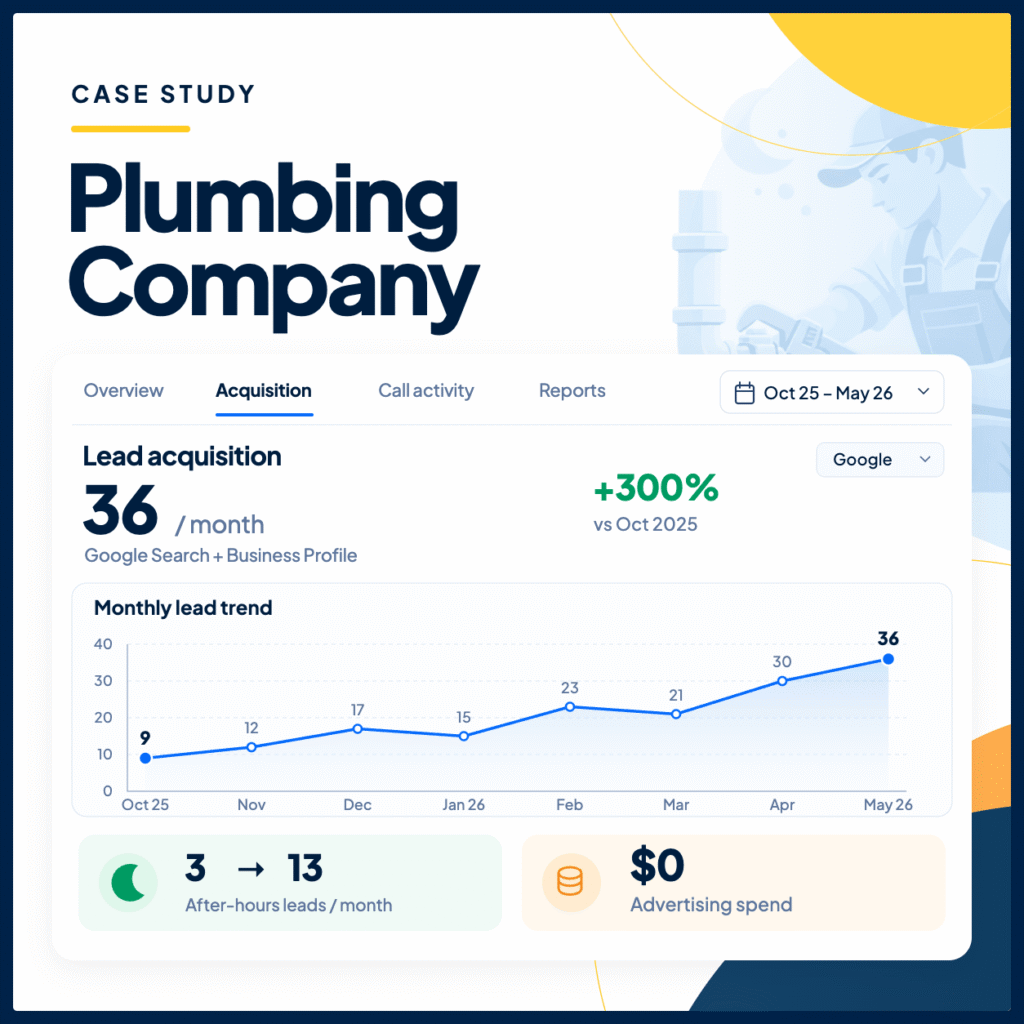
9 to 36 leads a month from Google search, six months after launch.
9 → 36
leads a month from Google
4 months
brief to launch
$0
on advertising
Overview (plumbing website design case study)
What we solved: Local visibility · Site structure · Lead generation
| AT A GLANCE | |
| Business | Family-owned plumbing company, Ohio. Emergency and everyday plumbing for homes and businesses, 24 hours a day, across four counties |
| Before | No website of its own. Work came from referrals and a new Google Business Profile |
| Scope | Website design and build, site structure, copy and on-page SEO |
| Timeline | Four months from brief to launch, November 2025 |
| Result | 9 to 36 leads a month from Google search, six months after launch |
| Advertising | $0 |
The problem (plumbing website not getting calls)
The company answers the phone at any hour. A burst pipe at 11 PM, a sump pump failing in a storm, a water heater that quits on a Sunday morning. That is the work it was built for, and almost nobody searching at those hours could find it.
The market had two kinds of plumber. The local firms in town were well reviewed, and none of them was open at night. The ones open all night were bigger firms based in the nearest city, with hundreds or thousands of Google reviews and a reach no family business could match on the map.
A new company with a few dozen reviews was never going to win the map on reviews alone. It needed people to find it another way, for the job they had and the town they were in.
“Most of our work used to come from people who already knew us. Now a lot of it comes from people who found us that night, with water on the floor.”
Owner, plumbing company, Ohio
5 things we found auditing a 24/7 plumber’s local market
1. The local competition went home at night
None of the well-reviewed plumbers in the client’s own town was open at night. Being open at 2 AM was the client’s real advantage, and nothing online said so.
2. The 24-hour firms couldn’t be beaten on reviews
The all-night options had between a few hundred and 21,000 Google reviews. Competing on the map alone meant losing, so the website had to carry the search.
3. People search for the job and the town, not the company
Someone with a flooded basement types the problem and where they are. One general services page can’t answer “sump pump repair” and “frozen pipes” for four counties at once. It’s the same idea as treating each location as its own market.
4. In an emergency, the phone number is the whole website
A homeowner with water on the floor won’t fill in a form or scroll for contact details. If the call button isn’t on the screen, the next plumber in the results gets the call.
5. A young company needed to show who would turn up
With few reviews, the strongest trust signal was the people. Real owners, real vans, licensed and insured, family-owned, stated plainly near the top.
6 things we built (local SEO for plumbers)
WHAT WE DID | WHY WE DID IT |
A homepage that says 24/7 in its first line, with the phone number in the header | The one advantage the local competitors couldn’t match is stated before anything else |
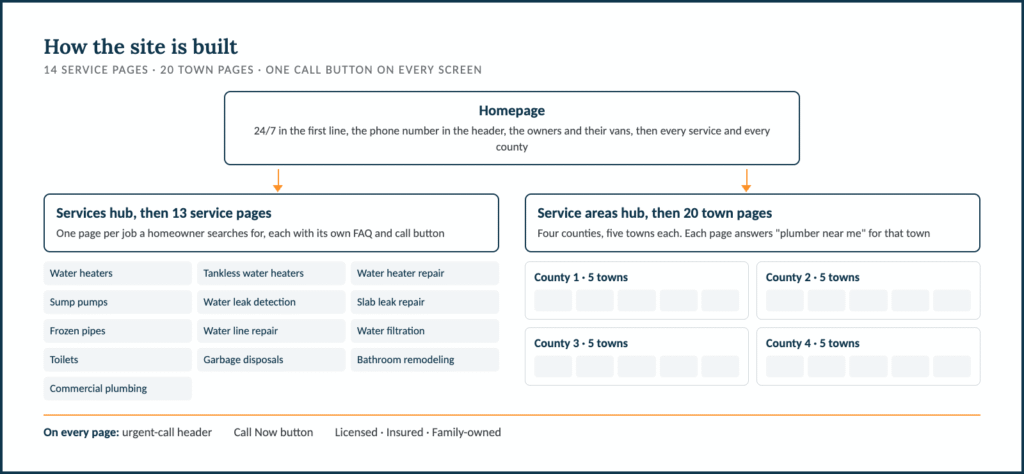
13 service pages and a services hub, one page per job: water heaters, sump pumps, leak detection, frozen pipes and more | Each page answers the exact problem someone searches for, so Google has a page to show for it |
20 town pages across four counties, under a service areas hub | Someone searching for a plumber in their town lands on a page about their town |
An urgent-call header and a Call Now button on every page, on desktop and mobile | The call is one tap away wherever the visitor lands, at any hour |
The owners, their photos and their vans on the homepage, with licensed, insured and family-owned badges | A new company borrows trust from the people who will actually arrive at the door |
FAQ blocks answering the questions asked before calling: are you open now, which areas, are you licensed | The doubts that delay a call are settled on the page |
It’s the approach behind building one page for every condition a patient searches for, applied to plumbing jobs and towns.
4 months, brief to launch
MONTH | WHAT HAPPENED |
Month 1 | Research on local competitors, their hours and reviews, and how people search. Structure agreed |
Month 2 | Design and the homepage, built around the 24/7 call and the owners |
Month 3 | Copy for the 13 service pages and the 20 town pages, county by county |
Month 4 | Build, schema, titles and descriptions, testing on phones, and launch |
9/mo to 36/mo leads in 6 months (calls from Google search)
MEASURE | BEFORE LAUNCH | 6 MONTHS AFTER LAUNCH |
Leads a month from Google search | 9 | 36 |
Leads a month after hours and at weekends | 3 | 13 |
Pages that can answer a search | None of its own | 34: 14 service pages and 20 town pages |
Advertising spend | $0 | $0 |
Leads are phone calls and enquiries from Google search and the Business Profile. Before: the month before launch. After: the sixth month after launch. After hours means after 6 PM on weekdays, and weekends.
Why it worked
We didn’t try to out-review the big firms. The advantage was already there: the company answered the phone at night when the local competition didn’t. We gave Google a page for every job and every town the company covers, and gave every visitor a phone number they could tap from the first screen.
Six months after launch, the company was getting four times as many leads a month from Google, more than a third of them outside office hours, with nothing spent on ads.
Frequently asked questions
How much does a website cost for a plumbing company?
Our website builds range from $1,000 to $10,000 or more, depending on page count and scope, and most land between $2,000 and $3,000. A site with a page for every service and every town you cover sits toward the upper part of that range, because each page is written for its own search. We quote a fixed price after a call, once we know your services and your area.
How can plumbers get more calls from Google?
Make it easy for Google to match you to the job and the town, and easy for the caller to reach you. That means a page for each service you offer, a page for each town you cover, the phone number on every screen, and a Google Business Profile with steady reviews. For this plumber, that took leads from Google from 9 to 36 a month in six months, with no ads.
Do service area pages work for plumbers?
They do when each page is genuinely about that town: the areas you cover there, how fast you can get there, the problems local homes have. Pages that copy one template and swap the town name rarely rank, and can hold a site back. This company has 20 town pages across four counties, each written for its town.
How long does it take to build a plumbing website?
A small site with a handful of pages takes 3 to 6 weeks. This one took four months from brief to launch, because it has a homepage, 14 service pages and 20 town pages, each with its own copy, FAQ and call button.
Do you answer the phone when your competitors don’t?
We’ll look at what someone in your area sees when they search for your services at night, and show you where the calls are going. 30 minutes, screen-shared, no cost.