Table of Contents
ToggleWe redesigned, rewrote and rebuilt his website in two weeks, around an ungated media kit.
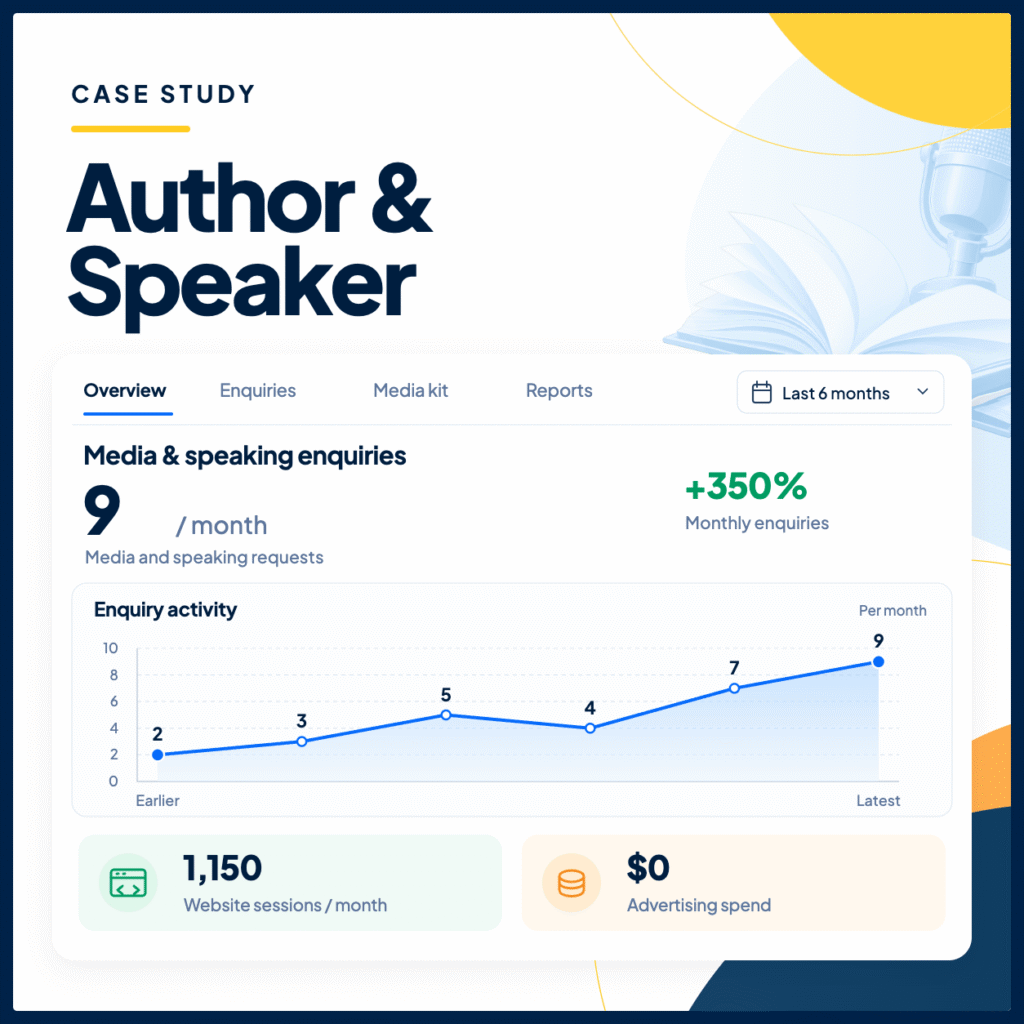
Six months after launch, media and speaking enquiries had gone from 2 a month to 9.
2 → 9/month
Media and speaking enquiries, 6 months after launch
2 weeks
Brief to launch
£0
On advertising
Overview
What we solved: Conversion · Referral pathways · Content
| Client | A nonfiction author, speaker and retired clinical psychologist in Florida |
| Category | Author platform and personal brand, health and chronic illness |
| Engagement | Website redesign, copywriting, development |
| Starting point | An existing four-page site, live, built around the book purchase |
| Timeline | 2 weeks, brief to launch |
| Stack | WordPress, Elementor |
| Not in scope | Video production, photography, press outreach |
The problem
He spent his career as the person with answers. Lecturer, clinical psychologist, national radio host. Then he became the patient. After more than a decade of inconclusive tests he was diagnosed with a rare chronic illness, and he wrote the book he had needed and could not find.
By the time he came to us he already had a website and a publisher. What he did not have was a website that worked for the second audience every author has and almost none build for.
An author’s website has two jobs. It sells copies, and it books appearances. Those are different visitors on different clocks. A reader will browse. A producer booking a segment, or a journalist filing by five o’clock, will not. They need a bio, a headshot at print resolution, a cover image, a line they can quote and proof the author is real. They need all of it without sending an email and waiting a day for the reply.
His site made readers welcome. Everyone else got a contact form.
“Every interview request started the same way. Could I send a bio, a photo, the cover. I was answering the same email three times a week.”
Author and retired clinical psychologist, Florida
6 things we found
The highest-value visitor was the one the site ignored
Press enquiries went through the same contact form as everything else. For an author, the interview is how new readers arrive and the book sale is what follows. The structure had it backwards. It is the same thinking as answering the funding question before the phone call for a dietitian in regional Queensland. Work out whose decision matters most, then build the page for them.
The credibility was in the reviewers, not the blurb
Six named, credentialed readers had written about the book. A linguistics PhD, a sociology PhD, a licensed clinical social worker, an associate professor of behavioural sciences, a practising physician and a nurse anaesthetist. That is professional endorsement, and it was sitting on the page as decoration.
A media kit behind a request form is not a media kit
The usual approach is a gated PDF. It costs the journalist an email and a wait. It costs the author the booking, because the next author on the list did not make them ask.
Outlets need two bios, not one
A programme listing needs sixty words. A feature needs four hundred. Supply one and an editor writes the other, and an editor writing your bio from scratch gets details wrong.
The subject was the search term, and the site never used it
A rare condition has a name. People type it into Google late at night after a bad appointment. Page titles and descriptions were not built around the words those readers actually search, It is the gap we closed for a London clinic by building pages around the words patients actually search.
A launch ends, a platform has to keep running
A site with nothing new on it six months after publication tells every visitor the story stopped.
7 changes we made
What we did | Why we did it |
A media kit as a full page, not a download. Author photos, cover images at print resolution, long bio, short bio, publisher interview, broadcast and print features, all on one indexable URL | A journalist on deadline can take everything they need in ninety seconds without contacting anyone. Nothing is gated, so nothing is lost to a slow reply |
Rewrote every page in his voice, working from the book and his own material rather than an author template | He is a clinician writing about his own illness. Copy that sounded like a sales page would have undercut the thing the book trades on, which is that he is telling the truth |
Split the two conversion paths. A retailer page for readers, a press path for media, each with its own call to action | Two audiences, two destinations. One shared funnel loses whichever audience it was not built for |
Built the enquiry form to qualify, not just collect. Outlet, topic, audience reach, deadline | He can tell a real booking from a vague one before replying. Managing a chronic illness, time and energy are the budget |
Rewrote titles and descriptions around the condition, the diagnosis journey and the book title | People searching the condition by name are the readers most likely to buy and least likely to hear about the book any other way |
Set up a blog to keep publishing after handover | New posts give readers a reason to return and give search engines a reason to keep crawling |
Designed for reading with a chronic illness. Generous type, high contrast, short line length, clean mobile layout | Many readers of a book about chronic pain are reading in pain, on a phone, lying down |
2 weeks, brief to launch
Stage | What happened |
Days 1–2 | Audit of the existing site, structure agreed, media kit approach proposed and signed off |
Days 3–6 | Copy written across all eight pages, working from the book and the client’s own material |
Days 7–11 | Design and build. Client-supplied photos, trailer, cover files and interview assembled into the media kit |
Days 12–14 | Titles and descriptions set, mobile pass, testing, launch |
2 to 9 enquiries a month, six months after launch
| Measure | Before | 6 months after launch |
| Media and speaking enquiries | 2/month | 9/month |
| Monthly sessions | 310/month | 1,150/month |
| Pages | 4 | 8 |
| Press path | General contact form | Full media kit page plus a qualifying press form |
| Bios available | One | Two, copy-ready, on the page |
| Press assets | On request | Downloadable at print resolution, ungated |
| Publishing after launch | None | Blog live, posts published after launch |
| Spent on advertising | $0 | $0 |
Why it worked
Nothing here was clever. It came down to who the website was for.
Most author websites are a shop with a biography attached, because that is what an author website looks like. A book rarely sells from a product page. It sells because someone with an audience talks about it, and that person needs to do their job without a single email of friction.
So we built the page that makes their job easy, put it one click from every page on the site, and left the gate off.
The same logic holds well outside publishing. Every business has a visitor whose decision is worth a hundred ordinary ones. The referral partner, the procurement lead, the person drawing up a shortlist. Most websites send that visitor to the same form as everyone else, which is why we build the website before anyone spends on traffic.
Frequently asked questions
Should an author media kit be a PDF or a web page?
A web page, with a PDF as an optional extra. A journalist on deadline takes what is in front of them. A gated PDF costs them an email and costs the author the booking. Put the bios, photos, cover images and quotable lines on an indexable page, and offer the PDF for anyone who wants it all in one file.
What should an author website include beyond the book?
Two paths. One for readers, with retailers, an excerpt and a blog. One for media, with a media kit, a press enquiry form that asks for outlet, reach and deadline, and previous coverage. Most author websites build the first and leave the second as a contact link.
How long does a website redesign take?
This one took two weeks from brief to launch, because the photos, video and interview already existed and the scope was fixed before the build began. A redesign that also needs new photography, new positioning or new content takes longer. The build is rarely the slow part.
Why put two bios on a media kit page?
Because outlets need two lengths. A programme listing needs around sixty words and a feature needs four hundred. Supply only one and an editor writes the other, and an editor writing your bio from scratch gets details wrong.
Can a website redesign increase media and speaking enquiries?
It can remove the friction that stops them. In this case enquiries went from 2 a month to 9 in the six months after launch, with no ad spend. Coverage still depends on the story and the outreach. The website’s job is to make saying yes easy for the person who found it.
Every website has one visitor worth a hundred ordinary ones. Is yours built for them?
We build the website first, then grow it with SEO and content. Send us yours and we’ll tell you what it’s costing you.